New Executive Committee: RC 09 Board 2023-2027
| President | Dorina ROSCA, The American University of Moldova, Moldova, dorina.rosca@gmail.com |
| Vice-President | Rukmini SEN, Dr B R Ambedkar University Delhi, India |
| Secretary/Treasurer | Brian DILL, University of Illinois, USA, dill@illinois.edu |
| Newspaper Editor Webmasters | Lutfun Nahar LATA, The University of Melbourne, Australia, l.lata@unimelb.edu.au Ulrike SChUERKENS, University Rennes 2, France Matthew SABBI, Freie Universität Berlin, Germany |
| Board Members | Paul Mamba DIEDHIOU, Université Rennes 2, France and Université Cheikh Anta Diop de Dakar, Senegal Habibul Haque KHONDKER, Zayed University, UAE (Ex-Oficio) Su-ming KHOO, National University of Ireland, Ireland Hasan MAHMUD, Northwestern University in Qatar, Qatar Uddhab Prasad PYAKUREL, Kathmandu University, Nepal Matthew SABBI, Freie Universität Berlin, Germany Ulrike SCHUERKENS, University Rennes 2, France (Ex-Oficio) |
V Forum of Sociology in Rabat, Morocco from July 7 to July 11, 2025
RC 09 will organize sessions on topics related to the Sociology of Development and Social Transformations.
ISA World Congress 2023: Program
The full program of the ISA World Congress 2023 is now available.
RC09 facilitates 11 sessions and 4 joint sessions in ISA 2023. Check the RC09 sessions here.
The XX ISA World Congress of Sociology will be in a hybrid format: both in-person and virtual participation is possible.

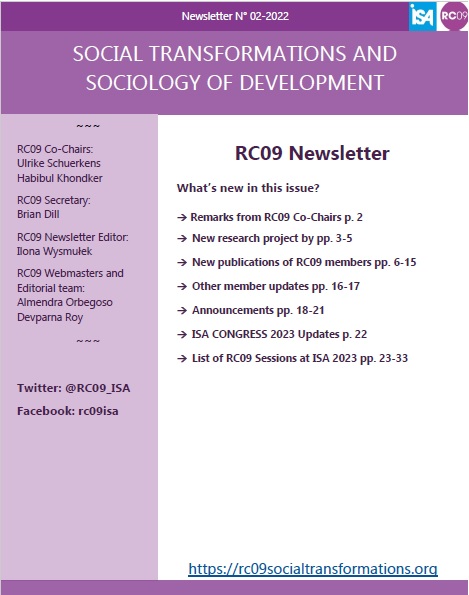
RC09 Newsletter – No 2-2022
The NEW RC09 Newsletter issue N° 02-2022 is freshly published!
We sincerely thank everyone who contributed to this issue!
What’s new in this issue?
- Remarks from RC09 Co-Chairs p. 2
- New research project by pp. 3-5
- New publications of RC09 members pp. 6-15
- Other member updates pp. 16-17
- Announcements pp. 18-21
- ISA CONGRESS 2023 Updates p. 22
- List of RC09 Sessions at ISA 2023 pp. 23-33
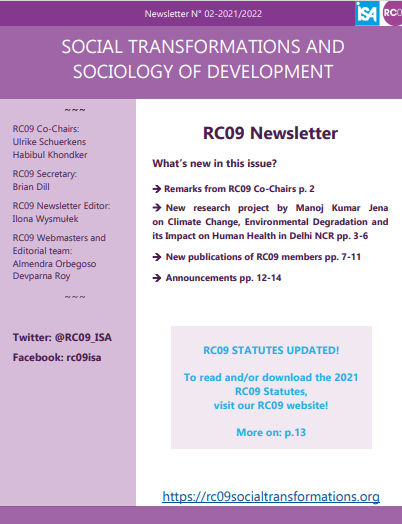
RC09 Newsletter issue 2021/2022(2)
We published the new issue of the RC09 Newsletter.
In this 2021/2022 RC09 Newsletter issue, you will find:
- Remarks from RC09 Co-Chairs p. 2
- New research project by Manoj Kumar Jena on Climate Change, Environmental Degradation and its Impact on Human Health in Delhi NCR pp. 3-6
- New publications of RC09 members pp. 7-11
- Announcements, including information about the updated Statutes of ISA RC09 pp. 12-14
We sincerely thank everyone who contributed to this issue!
Newsletter N° 2-2020 out now!
Click here to read the full Newsletter
We want to thank every contributor of this issue. Thanks to your time and experiences, the second Newsletter of the year is now a reality.
In this version you will find interviews in the pandemic context, book reviews, news, publications and more.
Enjoy the reading!

Send your contributions for the next RC09 Newsletter issue!
Deadline is on December, 7th! Don’t miss out the chance to share your work during pandemic times. Send your content to: jdubrow2000@gmail.com
RC09 Newsletter 2020-1: Pandemic Diaries is out now!
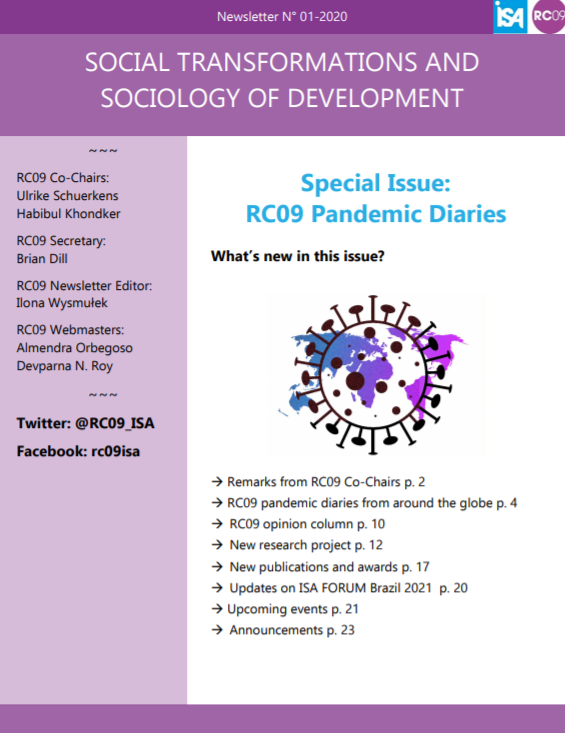 The RC09 Newsletter special issue is out!
Many thanks to everyone who contributed to making this new issue possible!
From India to Brazil, we heartfully thank every academic that shared their experiences during this global health crisis.
“As we all suffer from the same pandemic, the suffering reminds us that we are members of a common humanity. All over the world, countries have been exposed to lockdown of their societies to protect their health with huge socio-economic consequences.
(…) We are living through one of the greatest challenges of history and are supposed to create the future in this unique world that for the first time unify us against a common enemy. People are looking to science for a possible solution to overcome the crisis. But in this world of uncertainty, many are also turning to faith and spirituality that may assist them to overcome the pains and trauma of the pandemic.”
From Remarks of the RC09 Co-Chairs: Ulrike Schuerkens and Habibul Khondker
Click here to read the full Newsletter.
RC09 Newsletter 2020: Call for content!

For this Special Issue we invite you to write a brief (about 300-500 words) pandemic ‘diary’:
- How did your teaching, research and life change during these turbulent times?
- What are your thoughts about the prospects of online teaching and home office?
- What are your reflections on the functioning of society and its institutions in your countries during the pandemic?
Share your short pandemic diaries with us, so that we can collect them in this Special Issue and bring closer the situation of academics across the globe.
Also, we invite you to send us information about your new publications, grants, awards, past and upcoming conferences, seminars and workshops.
We are also eager to publish your book reviews and interviews with scholars from the field of social transformations and sociology of development.
The deadline to send your content is Monday, June 15, 2020, to rc09editors@gmail.com.
We look forward to your contributions!
Ilona Wysmulek and
Almendra Orbegoso
on behalf of the RC09 Editorial Team
 The Research Committee 09 - Social Transformations and Sociology of Development