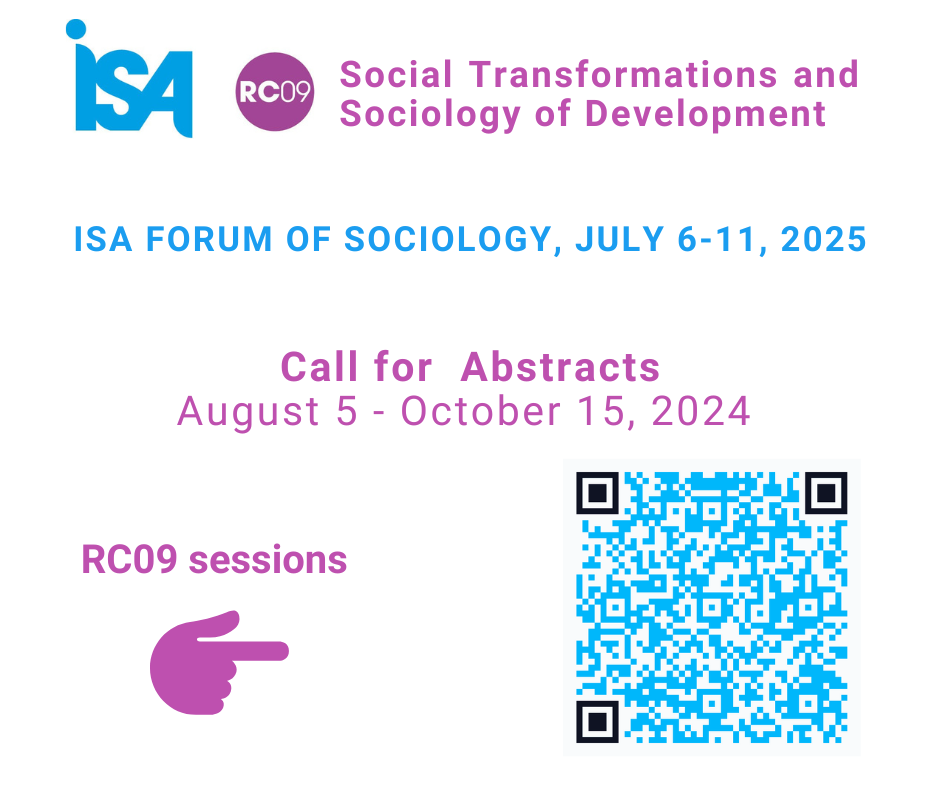
August 6 – October 15 2024.
Please find here the link to the submission at the ISA website.
We kook forward to receiving your submissions.
August 6 – October 15 2024.
Please find here the link to the submission at the ISA website.
We kook forward to receiving your submissions.
Vth ISA Forum in Rabat
Knowing Justice in the Anthropocene
RC 09 Programme proposal by Ulrike Schuerkens, Programme coordinator
RC 09 Social Transformations and Sociology of Development welcomes the topic of the 2025 (6-11 July) Forum in Rabat, Morocco. The Forum’s title is linked to fundamental issues treated in RC 09.
How to know justice in the Anthropocene? Solidarity is a feeling of unity between populations all over the world who have common interests and goals, who ask for justice in the Anthropocene. Confronted to a shared threat such as climate change, people will refer to solidarity to address this danger. The Anthropocene requires actions and cooperation between groups to reduce inequities within societies. Inequality within societies functions as a driver of consumption that damages the planet’s resources. Addressing the challenges of the Anthropocene requires solidarity between populations and institutions. Trust in governments, universities, research institutions and media is needed. Institutions should be accountable and fair. Solidarity among nations is also needed. Climate change is largely linked to activities done in the wealthy nations but also more recently in China and India. But the burden of climate change falls on the low- and middle-income countries. Needed funding must be given to poorer nations to undertake adaptation actions. Climate refugees from the global south must be welcome in the global north. Academic and scientific exchanges must be encouraged between nations.
By failing to accept these different tasks, we may transfer the negative outcomes of the climate change to our children and grandchildren. The Forum should thus discuss the current and near future situations and suggest global social dynamics and collective actions to navigate safely the Anthropocene. RC 09 sessions should focus on the above-mentioned topics, should discuss sociological fields such as inequality, trust, social media, gender, and obstacles in achieving global solidarity. Which sort of development is needed? How to respect local cultures and favour sustainable lifestyles and consumption behaviours? How can our professional organizations support these endeavours? How can we create opportunities to attain solidarity in the economy, in politics and culture?
We live in a global world where solidarity is needed to create justice in the Anthropocene.
==========================
Vème Forum ISA à Rabat
Connaître la justice dans l’anthropocène
Proposition de programme du RC 09 par Ulrike Schuerkens, coordinatrice du programme
La CR 09 Transformations sociales et sociologie du développement accueille favorablement le thème du Forum 2025 (6-11 juillet) à Rabat, au Maroc. Le titre du Forum est lié aux questions fondamentales traitées par la RC 09.
Comment connaître la justice dans l’Anthropocène ? La solidarité est un sentiment d’unité entre des populations du monde entier qui ont des intérêts et des objectifs communs et qui demandent la justice dans l’Anthropocène. Face à une menace commune telle que le changement climatique, les gens se référeront à la solidarité pour faire face à ce danger. L’Anthropocène exige des actions et une coopération entre les groupes pour réduire les inégalités au sein des sociétés. L’inégalité au sein des sociétés fonctionne comme un moteur de consommation qui endommage les ressources de la planète. Pour relever les défis de l’Anthropocène, il faut de la solidarité entre les populations et les institutions. La confiance dans les gouvernements, les universités, les instituts de recherche et les médias est nécessaire. Les institutions doivent être responsables et équitables. La solidarité entre les nations est également nécessaire. Le changement climatique est largement lié aux activités menées dans les pays riches, mais aussi, plus récemment, en Chine et en Inde. Mais le poids du changement climatique pèse sur les pays à revenus faibles et moyens. Les financements nécessaires doivent être accordés aux nations les plus pauvres pour qu’elles puissent entreprendre des actions d’adaptation. Les réfugiés climatiques du Sud doivent être accueillis dans le Nord. Les échanges universitaires et scientifiques doivent être encouragés entre les nations.
En n’acceptant pas ces différentes tâches, nous risquons de transférer les conséquences négatives du changement climatique à nos enfants et petits-enfants. Le Forum devrait donc discuter des situations actuelles et futures et suggérer des dynamiques sociales globales et des actions collectives pour naviguer en toute sécurité dans l’Anthropocène. Les sessions RC 09 devraient se concentrer sur les sujets susmentionnés, discuter de domaines sociologiques tels que l’inégalité, la confiance, les médias sociaux, le genre et les obstacles à la réalisation de la solidarité mondiale. Quel type de développement est nécessaire ? Comment respecter les cultures locales et favoriser des modes de vie et de consommation durables ? Comment nos organisations professionnelles peuvent-elles soutenir ces efforts ? Comment pouvons-nous créer des opportunités pour atteindre la solidarité dans l’économie, la politique et la culture ?
Nous vivons dans un monde global où la solidarité est nécessaire pour créer la justice dans l’Anthropocène.
RC 09 will organize sessions on topics related to the Sociology of Development and Social Transformations.
ISA Executive Committee decided to postpone the IV ISA Forum of Sociology until February 23-27, 2021. Registration deadline for presenters has been extended to December 15, 2020.
Message from the ISA President Prof. Sari Hanafi:
“We cannot stress enough that you are all in our thoughts in this extraordinary period – across so many domains of crisis. Please stay safe and care for your families and friends so that we all make it through in good health and strong of spirit.”
Sari Hanafi
President, International Sociological Association
Professor of Sociology, American University of Beirut

There is an open call for paper proposal to the international workshop “Institutional Transformations of Economy and Polity in Post-Communist States, 1990-2020 – Taking Stock, Looking Ahead“, which will be held in 15-19 June 2020 in Tbilisi State University, Georgia.
The workshop is co-organized by the Goethe University Frankfurt, Germany and Tbilisi State University, Georgia. It is funded by the German Academic Exchange Service (DAAD), which covers travel and accommodation costs for all invited participants.
Deadline for submission of abstracts (500 words): 15 March 2020.
The workshop “Institutional Transformations of Economy and Polity in Post-Communist States, 1990-2020: Taking Stock, Looking Ahead” puts a particular emphasis on experiences and challenges in the South Caucasus, yet of course also Russia, Ukraine and other former Soviet states are to be discussed. The workshop is set to discuss both theoretical and empirical studies on the following topics:
• The institutional evolution of the varieties and types of post-communist economies and polities, involving their interdependent relationship.
• The marketization of post-communist economies, involving the role of rules, norms and values as well as social structures in the evolution of firms, industries, and markets.
• The democratization of post-communist polities, involving populist and authoritarian tendencies as well as the interplay of formal and informal governance mechanisms.
To explore these issues, the workshop draws on an interdisciplinary perspective on institutional analyses from all fields of the social sciences and beyond, involving sociology, political science, economics, business, history, anthropology, and geography, among others.
You can find more information about the workshop here.
We are pleased to share with you the online program for the XIX ISA World Congress of Sociology, which will be held in Toronto, Canada this summer – July 15-21, 2018! You can browse the Program by day, by groups and by person index or you may search for particular presentations by typing key words, an author’s name, or the title. Here is the direct link to the scheduling details of the RC09 sessions and oral presentations.
RC09 sessions – ISA World Congress of Sociology – Online Program
Please note that the RC09 Business meeting will be held on Tuesday, 17 July 2018: 17:30-19:20. Location: 104D (MTCC NORTH BUILDING).
As the Toronto 2018 ISA Congress is approaching, you may want to learn more about its participants. In our last Newsletter issue, we have added a new section – the information about the current research projects and grants of the RC09 members. You can also find references (and sometimes full texts) of the recently published and forthcoming RC09 member publications on this website or in our RC09 Newsletter issues. For the curious ones, we encourage you to see (or remind yourself) the results of a very interesting initiative – the RC09 members’ survey 2016 – prepared by Josh Dubrow. The main goal of this survey is to understand the research interests of RC09 members, their daily life of scholars and attitudes toward the role of ISA RC09 in their lives.
The call for content for the next issue of our Newsletter will be announced soon. Stay tuned!
The registration for the XIX ISA World Congress of Sociology is now open. Do not miss the date! In order to be included in the program, the ISA congress participants must pay a full registration fee before March 20, 2018. All ISA members benefit from a discount registration fee. If you plan to renew or acquire ISA membership, remember that the processing takes 2 to 3 days. Read more about the Congress registration fees and ISA membership.
 The Research Committee 09 - Social Transformations and Sociology of Development