Author: uschuerk
Last Newsletter Summer 2025
CONTENTS
Message from RC09 President p.2
New Books p.3
New Articles and Book Chapters p.5
Integrative Sessions at the 5th ISA Forum of Sociology p.12
Announcements p.14
New Members Spotlight p.15
Women Entrepreneurship in Senegal: Best Student Paper: A.-A. Dembélé
2025 RC 09 Competition for Best Post-Graduate Student Paper Award
The winner of this prize is Abdul-Aziz Dembélé, a PhD student at the University Rennes 2, France. He is currently finalizing his doctoral thesis and expects to submit his thesis in the upcoming 2025-2026 academic year. His award-winning article is titled:
“New Figures in Women’s Entrepreneurship in Sub-Saharan Africa: Dakar Women Entrepreneurs between the Global and the Local.”
The paper is based on fieldwork conducted in Senegal and will be presented at the ISA Forum in Rabat, Morocco. RC 09 congratulates Abdul-Aziz Dembélé for his outstanding achievement.
Abstract
The literature on women’s entrepreneurship in sub-Saharan Africa is characterised by two main figures: that of ‘success’, embodied by the businesswoman involved in transnational trade networks, and that of ‘survival’, illustrated by the trader in the informal economy. Based on a field study conducted in Dakar, Senegal, this paper paints a portrait of fifteen women entrepreneurs. Most of these women have a high level of education and their businesses operate in the formal sector. Using a comprehensive sociological framework, the aim of this paper is to give an account of the subjective meaning that these women give to their entrepreneurial commitment and the ways in which it unfolds. The analysis is divided into two parts. The first looks at the rationale behind their entrepreneurial activities. This part shows that business creation, a complex and multidimensional phenomenon, is expressed by these women through personal dispositions, individual or family aspirations, the discovery of business opportunities and economic constraints. Far from being confined solely to subjective dimensions, the analysis of these women’s entrepreneurial commitment is set in a broader socio-economic context characterised by migratory phenomena, the increased responsibility of women in the household economy, the tightening of conditions of access to employment for young people and the recent pandemic of COVID-19. The second part looks at the economic, cognitive, social and institutional resources on which these women rely to develop their businesses. By showing that a large proportion of these resources are acquired or have been acquired through social trials and institutional selection mechanisms, it will be argued that these women’s entrepreneurial commitment is experienced and expressed as a form of ‘self-affirmation’ in contrast to the public. The implications of the results of this work are discussed both at the level of the academic field, where there is little existing study on these new figures of women’s entrepreneurship in Africa, and at the level of policymaking, where the need to redefine current policies to promote entrepreneurship in Africa will be emphasised.
RC 09 Newsletter Winter 2024
Award for Best Post-Graduate Student Paper RC 09 5th ISA Forum in Rabat (French version below)
2025 Competition for Best Post-Graduate Student Paper Award
The International Sociological Association Research Committee on Social Transformations and Sociology of Development (ISA RC 09) is pleased to announce for the first time a competition for the award honoring the best post-graduate student paper related to sociological research on social transformations. The winner/s will present her/his/their paper in one of RC09’s scheduled sessions at the V ISA Forum of Sociology in Rabat, Morocco, 6-11 July 2025 and their name(s) will be published in the RC 09 Newsletter. The award consists of a certificate with a citation and a monetary reward in the amount of up to Euros 500,00 or of 500,00 Euros each in the case of a co-authored paper which can be used toward expenses for attending the Forum. A summary of the finalist paper will be published in the RC 09 Newsletter.
Eligibility
Eligible are postgraduate student-authored papers accepted for inclusion into RC09’s program at the V ISA Forum of Sociology in Rabat. The author(s) must be registered for a postgraduate degree at a degree granting institution at the time the paper is submitted. Employment as academic staff or junior faculty is no reason for exclusion. Candidates must hold an undergraduate degree (B.A. or equivalent) and must be a Ph.D. student (or equivalent) no more than two years before the completion of the PhD at the time the paper is submitted. A letter of the supervisor must be included confirming the date of the defence. Not eligible are papers that were co-authored with a faculty advisor or someone holding a Ph.D. (or its equivalent), that have been published already, or that have been accepted for publication more than three years prior to submission. Papers must be submitted in English or French with an accompanying English translation in the latter case. The maximum length for the paper is 5,000 words, including bibliography, plus an abstract of not more than 500 words. Winners must be member of both the ISA and RC09 at the time of receiving the award.
Deadline to submit full paper: 15 February 2025
How to submit
Applications must be emailed to dorina.rosca@gmail.com with a copy to uschuerkens@gmail.com and the words “Post-Graduate Student Award 2025” in the subject line and the paper and cover letter as separate attached files. The paper must follow scholarly standards, including proper referencing and documentation of sources. It should be typed double spaced in 12-point font on numbered pages in a standard size (such as A4 or US letter of around 21cm × 29cm) with 3 cm margins. Notes and the bibliography should appear at the end. The paper may be formatted in one of these two formats: Adobe PDF (*pdf),or Word document (*.doc). The front page should bear the paper’s title, brief abstract, and up to five keywords, but not the author(s) name or affiliation.
The cover letter must include author(s) names, full contact information (for the period until July 2025), paper title, and a brief curriculum vitae indicating which institutions were attended in what years and what degrees were obtained or are in progress. The names of degrees must be indicated in the original language; English translation or explanation of equivalency may be added.
Candidates normally residing in the Economic South (= ISA’s category B/C countries) are encouraged to provide further details on their residency status and periods spent abroad to be considered for further special mentioning.
Submissions not conforming to these rules run risk of rejection. The jury reserves the right to request further particulars.
Selection
The papers will be evaluated by an international jury of distinguished scholars. The primary criteria for selection are originality of ideas, social relevance, conceptual rigor, analytical perceptiveness, and clarity of style.
In accordance with RC09’s Award Rules, the jury can decide to split the award, extend special recognition for the best paper from the Economic South (ISA’s category B/C countries), make honorary mentions of runners-up, or to not give an award at all. The winner(s) will be notified in or around late March 2025 so that the inscription to the Forum can be paid by the prize.
============================
Prix du meilleur article d’un étudiant diplômé inscrit en doctorat
2025 Concours pour le prix du meilleur article d’étudiant diplômé inscrit en doctorat
Le Comité de recherche de l’Association internationale de sociologie sur les transformations sociales et la sociologie du développement (ISARC09) a le plaisir d’annoncer pour la première fois un concours pour le prix récompensant le meilleur article d’étudiant diplômé inscrit en doctorat lié à la recherche sociologique sur les transformations sociales. Le(s) lauréat(s) présentera(ont) son(leur) article lors d’une des sessions programmées du RC09 au Vème Forum ISA de Sociologie à Rabat, Maroc, 6-11 juillet 2025 et son(leur) nom sera(ont) publié(s) dans le bulletin d’information du RC09. Le prix consiste en un certificat avec une citation et une récompense monétaire d’un montant maximum de 500,00 euros ou de 500,00 euros chacun dans le cas d’un article co-écrit, qui peut être utilisé pour couvrir les dépenses liées à la participation au Forum. Un résumé de l’article finaliste sera publié dans la lettre d’information RC 09.
Critères d’éligibilité
Sont éligibles les articles rédigés par des étudiants de troisième cycle et acceptés pour être inclus dans le programme du RC09 lors du Vème Forum ISA de Sociologie à Rabat. Les auteurs doivent être inscrits à un programme d’études supérieures doctorales dans un établissement d’enseignement supérieur au moment de la soumission de l’article. Le fait d’être membre du personnel académique ou de la faculté n’est pas un motif d’exclusion. Les candidats doivent être titulaires d’un diplôme de premier cycle (B.A. ou équivalent) et être étudiants en doctorat (ou équivalent) au plus tard deux ans avant la fin du doctorat au moment de la soumission de l’article. Une lettre du directeur de thèse confirmant la date de la soutenance doit être jointe. Ne sont pas éligibles les articles cosignés avec un conseiller pédagogique ou un titulaire d’un doctorat (ou son équivalent), qui ont déjà été publiés ou qui ont été acceptés pour publication plus de trois ans avant la soumission de l’article. Les articles doivent être soumis en anglais ou en français, accompagnés d’une traduction en anglais dans ce dernier cas. La longueur maximale de l’article est de 5 000 mots, bibliographie comprise, plus un résumé de 500 mots maximum. Les lauréats doivent être membres de l’ISA et du RC09 au moment où ils reçoivent le prix.
Date limite de soumission de l’article complet : 15 février 2025
Comment soumettre une candidature
Les candidatures doivent être envoyées par courrier électronique à dorina.rosca@gmail.com avec une copie à uschuerkens@gmail.com et les mots « Post-Graduate Student Award 2025 » dans la ligne d’objet, ainsi que l’article et la lettre d’accompagnement en tant que fichiers joints séparés. L’article doit respecter les normes scientifiques, notamment en ce qui concerne les références et la documentation des sources. Il doit être dactylographié en double interligne, en caractères de 12 points, sur des pages numérotées de taille standard (A4 ou US letter d’environ 21 cm × 29 cm) avec des marges de 3 cm. Les notes et la bibliographie doivent figurer à la fin. Le document peut être présenté dans l’un des deux formats suivants : Adobe PDF (*pdf) ou Word (*.doc). La première page doit comporter le titre de l’article, un bref résumé et jusqu’à cinq mots-clés, mais pas le nom ou l’affiliation de l’auteur.
La lettre d’accompagnement doit inclure les noms des auteurs, leurs coordonnées complètes (pour la période allant jusqu’à juillet 2025), le titre de l’article et un bref curriculum vitae indiquant les établissements fréquentés en quelles années et les diplômes obtenus ou en cours d’obtention. Les noms des diplômes doivent être indiqués dans la langue d’origine ; une traduction en anglais ou une explication de l’équivalence peut être ajoutée.
Les candidats résidant normalement dans le Sud économique (= pays de la catégorie B/C de l’AIS) sont encouragés à fournir des détails supplémentaires sur leur statut de résident et les périodes passées à l’étranger afin d’être pris en considération pour une mention spéciale supplémentaire.
Les candidatures ne respectant pas ces règles risquent d’être rejetées. Le jury se réserve le droit de demander des informations complémentaires.
La sélection
Les articles seront évalués par un jury international composé d’éminents chercheurs. Les principaux critères de sélection sont l’originalité des idées, la pertinence sociale, la rigueur conceptuelle, la perspicacité analytique et la clarté du style.
Conformément au règlement du prix RC09, le jury peut décider de diviser le prix, d’accorder une reconnaissance spéciale au meilleur article provenant du Sud économique (pays de la catégorie B/C de l’ISA), d’accorder des mentions honorifiques aux finalistes ou de ne pas décerner de prix du tout. Le(s) lauréat(s) sera(ont) notifié(s) vers la fin du mois de mars 2025 afin que l’inscription au Forum puisse être payée par le prix.
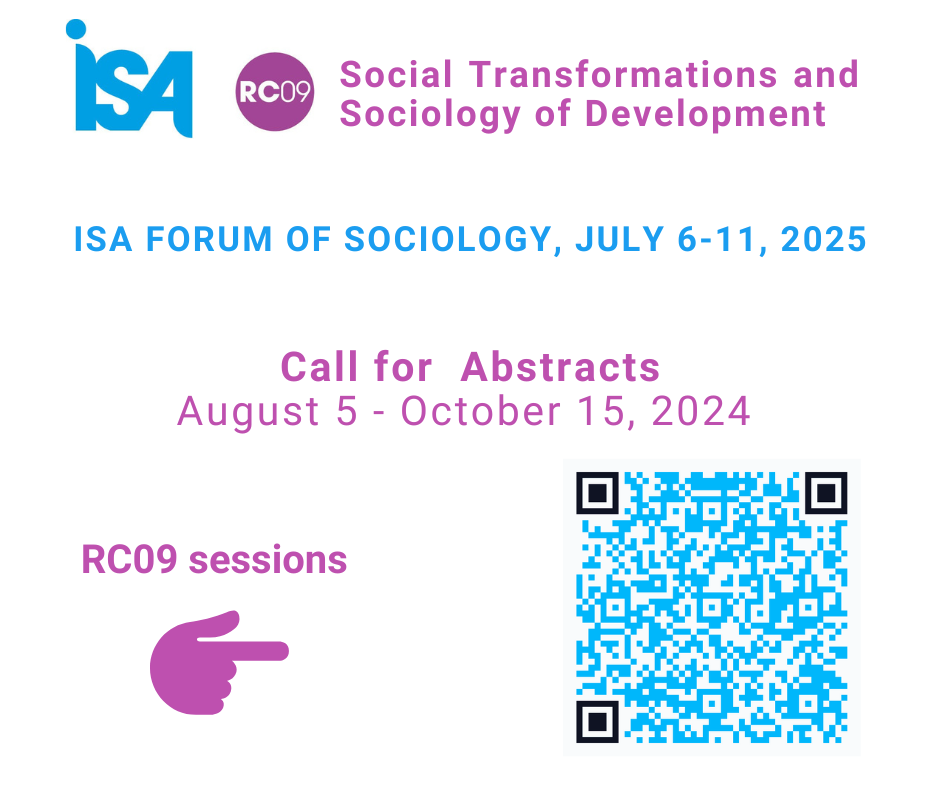
Call for abstracts ISA Forum Rabat
August 6 – October 15 2024.
Please find here the link to the submission at the ISA website.
We kook forward to receiving your submissions.
RC 09 Programme proposal for the Rabat Form
Vth ISA Forum in Rabat
Knowing Justice in the Anthropocene
RC 09 Programme proposal by Ulrike Schuerkens, Programme coordinator
RC 09 Social Transformations and Sociology of Development welcomes the topic of the 2025 (6-11 July) Forum in Rabat, Morocco. The Forum’s title is linked to fundamental issues treated in RC 09.
How to know justice in the Anthropocene? Solidarity is a feeling of unity between populations all over the world who have common interests and goals, who ask for justice in the Anthropocene. Confronted to a shared threat such as climate change, people will refer to solidarity to address this danger. The Anthropocene requires actions and cooperation between groups to reduce inequities within societies. Inequality within societies functions as a driver of consumption that damages the planet’s resources. Addressing the challenges of the Anthropocene requires solidarity between populations and institutions. Trust in governments, universities, research institutions and media is needed. Institutions should be accountable and fair. Solidarity among nations is also needed. Climate change is largely linked to activities done in the wealthy nations but also more recently in China and India. But the burden of climate change falls on the low- and middle-income countries. Needed funding must be given to poorer nations to undertake adaptation actions. Climate refugees from the global south must be welcome in the global north. Academic and scientific exchanges must be encouraged between nations.
By failing to accept these different tasks, we may transfer the negative outcomes of the climate change to our children and grandchildren. The Forum should thus discuss the current and near future situations and suggest global social dynamics and collective actions to navigate safely the Anthropocene. RC 09 sessions should focus on the above-mentioned topics, should discuss sociological fields such as inequality, trust, social media, gender, and obstacles in achieving global solidarity. Which sort of development is needed? How to respect local cultures and favour sustainable lifestyles and consumption behaviours? How can our professional organizations support these endeavours? How can we create opportunities to attain solidarity in the economy, in politics and culture?
We live in a global world where solidarity is needed to create justice in the Anthropocene.
==========================
Vème Forum ISA à Rabat
Connaître la justice dans l’anthropocène
Proposition de programme du RC 09 par Ulrike Schuerkens, coordinatrice du programme
La CR 09 Transformations sociales et sociologie du développement accueille favorablement le thème du Forum 2025 (6-11 juillet) à Rabat, au Maroc. Le titre du Forum est lié aux questions fondamentales traitées par la RC 09.
Comment connaître la justice dans l’Anthropocène ? La solidarité est un sentiment d’unité entre des populations du monde entier qui ont des intérêts et des objectifs communs et qui demandent la justice dans l’Anthropocène. Face à une menace commune telle que le changement climatique, les gens se référeront à la solidarité pour faire face à ce danger. L’Anthropocène exige des actions et une coopération entre les groupes pour réduire les inégalités au sein des sociétés. L’inégalité au sein des sociétés fonctionne comme un moteur de consommation qui endommage les ressources de la planète. Pour relever les défis de l’Anthropocène, il faut de la solidarité entre les populations et les institutions. La confiance dans les gouvernements, les universités, les instituts de recherche et les médias est nécessaire. Les institutions doivent être responsables et équitables. La solidarité entre les nations est également nécessaire. Le changement climatique est largement lié aux activités menées dans les pays riches, mais aussi, plus récemment, en Chine et en Inde. Mais le poids du changement climatique pèse sur les pays à revenus faibles et moyens. Les financements nécessaires doivent être accordés aux nations les plus pauvres pour qu’elles puissent entreprendre des actions d’adaptation. Les réfugiés climatiques du Sud doivent être accueillis dans le Nord. Les échanges universitaires et scientifiques doivent être encouragés entre les nations.
En n’acceptant pas ces différentes tâches, nous risquons de transférer les conséquences négatives du changement climatique à nos enfants et petits-enfants. Le Forum devrait donc discuter des situations actuelles et futures et suggérer des dynamiques sociales globales et des actions collectives pour naviguer en toute sécurité dans l’Anthropocène. Les sessions RC 09 devraient se concentrer sur les sujets susmentionnés, discuter de domaines sociologiques tels que l’inégalité, la confiance, les médias sociaux, le genre et les obstacles à la réalisation de la solidarité mondiale. Quel type de développement est nécessaire ? Comment respecter les cultures locales et favoriser des modes de vie et de consommation durables ? Comment nos organisations professionnelles peuvent-elles soutenir ces efforts ? Comment pouvons-nous créer des opportunités pour atteindre la solidarité dans l’économie, la politique et la culture ?
Nous vivons dans un monde global où la solidarité est nécessaire pour créer la justice dans l’Anthropocène.
 The Research Committee 09 - Social Transformations and Sociology of Development